Showing posts with label drinking water. Show all posts

05 June 2010

Food and Fuel Consumption the Biggest Environmental Stressors

Today is World Environment Day. On that occasion, UNEP (United Nations Environmental Programme) this week released a report "Assessing Environmental Impacts of Production and Consumption" (press release: here, also in The Guardian). The report looks at the compound environmental impacts for human health, ecosystem health, and natural resources from industrial/agricultural production and also from a human consumption point of view. The report concludes that use of fossil fuels and consumption of foods have the most significant environmental impacts including impacts on the availability and quality of water resources:

23 May 2010

For want of a drink

...is the title of a phantastic special issue on water in the Economist this week. An absolutely worthwhile read, front to back, for anyone interested in a primer on the global context of water, drinking water, sanitation, food production, water scarcity, water pollution, water management, and water politics and its importance to the planet's livelihood and survival. The report touches on all the important areas and does it well, REALLY well! The author, John Grimond, is to be congratulated to this series. This is the best thing "water" in the general media that I have ever seen, when it comes to providing an overview of water issues around the globe. It is an extremely timely article. It comes just ahead of our conference on "Sustainable Groundwater in Agriculture: An International Conference Linking Science with Policy", 15-17 June 2010, in San Francisco. Conference speakers include a number of the experts that John consulted with in preparation for his articles.

From my perspective - and related to several of the notes below - kudos to John Grimond also for making a successful effort to convey the hydrologic concept of "consumptive water use" (water that goes to evapotranspiration) in contrast to non-consumptive water uses (e.g., water down the kitchen sink), for pointing out the importance of agricultural water use and its link to feeding the world, for getting it right on the importance of crop ET, and for the clever integration of groundwater concepts into this whirlwind tour of global water.

Here is a list of links to the individual articles:

05 April 2009

Nitrogen Fertilizer Centennial

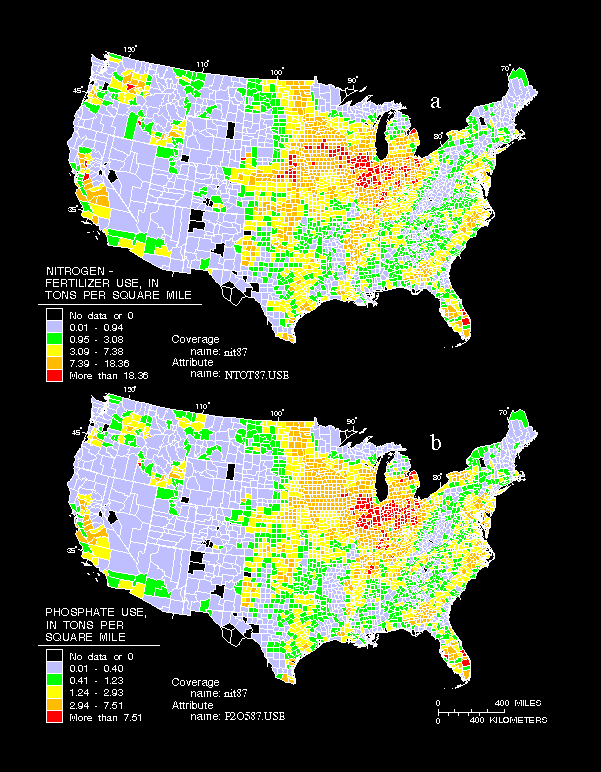
One hundred years of nitrogen fertilizer - and what an incredible green revolution it has been! The article below from Scientific American highlights some of the current issues with global fertilizer use in the context of biofuels. Funny that the article should leave out any mention of groundwater. Nitrate is only the most common groundwater contaminant worldwide next to salt. In California nearly 10% of water supply wells are at levels above the maximum contaminant level (MCL) of 45 mg/L (Nitrate) or 10 mg/L (Nitrate-Nitrogen). In a recent survey of domestic wells in Tulare County, California, over 40% of domestic wells exceeded the nitrate MCL. The county is one of the largest agricultural producers in the country with large acreages of citrus, vineyards, tree crops, and forage crops. It is also the largest dairy producer in the United States. Dr. Erik Ekdahl from the California SWRCB recently gave an illustrative presentation with maps showing 1980-2007 groundwater nitrate trends in California based on results from nearly 10,000 wells. If you are a GRA member, you can download his presentation from their website.