Showing posts with label groundwater. Show all posts

20 June 2010

Toward Sustainable Groundwater in Agriculture - Linking Science with Policy

...that was the title of our international conference this week in Burlingame/San Francisco. Complete with pre-conference workshops and a post-conference tour of lovely Sonoma Valley and it's dairies and wineries. The conference was an amazing gathering of movers and shakers, thinkers and tinkerers, decision-makers, policy makers, planners, farmers, ag-industry representatives, consultants, students, even high-school students, and researchers. Attendees came from California, from across the United States, and from around the globe - Asia, Africa, Europe, Latin America, Australia. All had one thing in common - a shared interest in groundwater resources of agricultural regions and in agriculture's role in sustaining groundwater resources for future uses in agriculture and for other uses.

If you want to get a flavor for the information from the conference - Michael Campana blogged about the meeting this week (thank you, Michael!) - he was one of our final panelists. And here are my own personal - and much drier - "classroom notes" from the conference, covering about a quarter of the presentations. Mind that these are unedited and I am not guaranteeing either completeness nor accuracy! Vivian Jensen generously provided her notes as well.

23 May 2010

For want of a drink

...is the title of a phantastic special issue on water in the Economist this week. An absolutely worthwhile read, front to back, for anyone interested in a primer on the global context of water, drinking water, sanitation, food production, water scarcity, water pollution, water management, and water politics and its importance to the planet's livelihood and survival. The report touches on all the important areas and does it well, REALLY well! The author, John Grimond, is to be congratulated to this series. This is the best thing "water" in the general media that I have ever seen, when it comes to providing an overview of water issues around the globe. It is an extremely timely article. It comes just ahead of our conference on "Sustainable Groundwater in Agriculture: An International Conference Linking Science with Policy", 15-17 June 2010, in San Francisco. Conference speakers include a number of the experts that John consulted with in preparation for his articles.

From my perspective - and related to several of the notes below - kudos to John Grimond also for making a successful effort to convey the hydrologic concept of "consumptive water use" (water that goes to evapotranspiration) in contrast to non-consumptive water uses (e.g., water down the kitchen sink), for pointing out the importance of agricultural water use and its link to feeding the world, for getting it right on the importance of crop ET, and for the clever integration of groundwater concepts into this whirlwind tour of global water.

Here is a list of links to the individual articles:

02 November 2009

Surviving (Mega-) Droughts - Of Course on Groundwater!

Two speakers with real world examples on the role of groundwater in today's world of drought preparedness followed Scott Stine's talk in a session on managing drought, held at this year's Biennial Groundwater Conference. Dr. Behrooz Mortazavi, Eastern Municipal Water District (EMWD), and Gary Serrato, Fresno Irrigation District, explained the many elements of their respective district's conjunctive use management approaches.

30 October 2009

Surviving Mega-Droughts - on Groundwater?

At the recent California Biennial Groundwater Conference, I was assigned to chair a special session on "Thriving (or Surviving) in Times of Drought". Scott Stine, California State University East Bay, opened the session with his fascinating story and review of California's medieval mega-droughts. He is known perhaps mostly for his discovery and age-dating of old tree stands hidden below the surface of Mono Lake until recent water diversions to LA substantially lowered the lake level. At the meeting, Scott unfolded a story of varied evidence from many more places - from Point Reyes at the Pacific Coast to Walker Lake and Pyramid Lake in the Great Basin - that consistently tell of large mega-droughts, one between approximately 900-1100 AD and another from approximately 1200-1350 AD.

09 October 2009

Inconvenient Truth: Some "Green" Energy Can Guzzle Water

...that was the title that the Davis Enterprise used for Todd Woody's recent NY Times article exploring a recent surge in solar projects and a recognition of the need for sometimes significant amounts of water being consumed by large-scale commercial solar power plants. The title caught my eye. Being a numbers guy by nature, I was wondering what this article may be calling a "guzzler". The lead example for the article (and associated blog) were two planned solar farms in the Amargosa Valley (right next to Death Valley). Annual consumption would be 1.3 billion gallons of water per year. Sounds like a lot of water, doesn't it? I prefer to use cubic meters or acre-feet and compare it to equivalent farm-water use, which is where most of our water use is besides environmental flows - I think that would provide a much better perspective than the one-gallon water bottle we buy in the supermarket:

20 August 2009

Water History

The International Water History Association, through Springer, just began a new journal: "Water History". The journal promises to be a great resource for folks interested in all aspects of water and how humans' interactions with water have shaped our landscapes, our societal structures, and our history. The editorial in the inaugural issue explores the journal aspirations in more depth. Very readable material for everyone!

19 August 2009

Loosing Groundwater at the Grand Scale

This week, an intriguing study, in which scientists used satellites to determine groundwater depletion at the continental scale, put the spotlight on groundwater withdrawals in India. [Original article in Nature (for those with access via their library), a review in the Washington Post and in the ScienceBlog]. Very timely article for Americans worried about dwindling groundwater resources in the High Plains Aquifer, in the arid Southwest, or in California. The article, by Matthew Rodell and others, reported that, over a six-year period, the average annual loss of groundwater across three states in northwestern India (not just a single small basin) was about 4 cm (1.6 inches) equivalent height of water or nearly 18 cubic kilometers per year across the 450,000 sq.km (170,000 sq.miles) region. At 12% specific yield (the proportion of the ground actually occupied by groundwater), this means an average annual decline of 0.33 m (1 foot) across that entire region. During the period of observation (2002-2008), the precipiation in Northwest India was reported to be about average.

06 April 2009

The Spiritual Power of Groundwater!

Springs and seeps and sinks. I always am impressed by water simply appearing out of no-where or disappearing into no-where. Well, not exactly no-where - it is out of the ground or back into the ground. An ephemeral realization of that which is invisibly beneath - groundwater. I grew up in a humid temperate climate, so a spring was an every day thing, although large springs have always been particularly impressive. It wasn't until I moved to the desert Southwest that I first experienced the opposite - a stream disappearing into the underground of a sandy streambed at full speed (the Canada del Oro as it leaves the Catalina Mountains north of Tucson, AZ). My video is posted here:

05 April 2009

Farm Nitrogen Balance for CA

I am working on an article for the upcoming Nitrate issue of Southwest Hydrology. One of the big picture numbers that I have been following is the statewide farm nitrogen balance in California. Here is the back-of-the-envelope computation that I am coming up with - somebody correct me if I am way wrong:

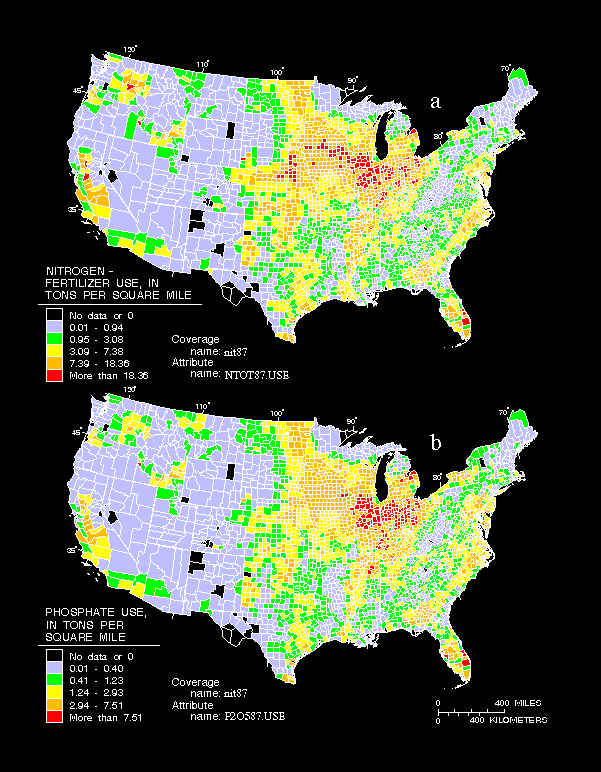
Nitrogen Fertilizer Centennial

One hundred years of nitrogen fertilizer - and what an incredible green revolution it has been! The article below from Scientific American highlights some of the current issues with global fertilizer use in the context of biofuels. Funny that the article should leave out any mention of groundwater. Nitrate is only the most common groundwater contaminant worldwide next to salt. In California nearly 10% of water supply wells are at levels above the maximum contaminant level (MCL) of 45 mg/L (Nitrate) or 10 mg/L (Nitrate-Nitrogen). In a recent survey of domestic wells in Tulare County, California, over 40% of domestic wells exceeded the nitrate MCL. The county is one of the largest agricultural producers in the country with large acreages of citrus, vineyards, tree crops, and forage crops. It is also the largest dairy producer in the United States. Dr. Erik Ekdahl from the California SWRCB recently gave an illustrative presentation with maps showing 1980-2007 groundwater nitrate trends in California based on results from nearly 10,000 wells. If you are a GRA member, you can download his presentation from their website.